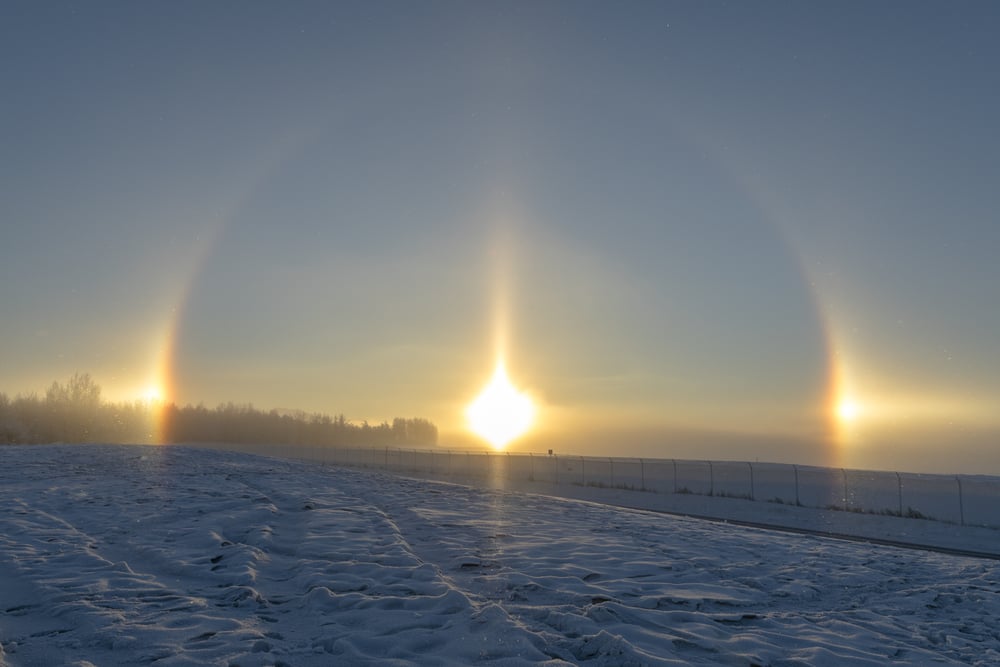
If you’ve ever stepped outside on a cold winter morning and spotted what looked like three suns rising in the sky, you’re not imagining things. You may have witnessed some parhelia, more commonly known as sun dogs or light dogs, a dazzling optical display created by the clouds and crystals in the atmosphere.
What are sun dogs?
Sun dogs are bright, rainbow-tinted patches of light that appear on either side of the Sun, often forming a horizontal line through it. They can be subtle glows or dramatically bright “mock suns.”
While the origin of the name “dogs” isn’t certain, the most popular theory is that they are named dogs as these lights “follow” the Sun like loyal companions. Though they can technically appear during any season, light dogs are most common in winter.
The geometry of sun dogs
High in the atmosphere, typically in cirrus or cirrostratus clouds, millions of tiny hexagonal ice crystals float like microscopic snowflakes. Shaped like flat plates, these crystals tend to align horizontally as they fall, acting as prisms that bend sunlight.
Sunlight enters one crystal face and exits through another, bending the light about 22°. When millions of crystals are aligned the same way, they create a pair of bright, rainbow-tinted points flanking the Sun, producing the illusion of “mock suns”.
Sun dogs usually appear as a pair because the uniform orientation of the crystals ensures that sunlight bends in a consistent pattern. Occasionally, you might see only one, but the other may simply be hidden by clouds, buildings, or other obstructions.
The colours of sun dogs result from the way light bends through ice crystals. Shorter wavelengths, like blue and violet, bend more strongly than longer wavelengths, like red and orange, producing a reddish inner edge and a bluish outer edge.
Why winter is sun dog season
If sun dogs can form any time there are ice crystals in the sky, why do we notice them most in winter? Several factors make winter the prime season for these dazzling displays.
Cold air encourages the formation of cirrus clouds filled with ice crystals, providing ideal conditions for sun dogs. At the same time, the low winter Sun places light in the perfect position to bend through the crystals and create the characteristic bright spots.
We are also more likely to witness sunrises and sunsets during winter, when these events sync perfectly with the morning or evening commute or school run.
How to spot sun dogs
If you want to see light dogs for yourself, here’s the best way to do so:
1. Look at the horizon during sunrise or sunset when the Sun is low.
2. Scan for thin, wispy cirrus clouds.
3. Never stare directly at the Sun; instead, watch for light patches off to the left and right.
4. Cameras(especially smartphones) often pick up faint sun dogs better than the naked eye.
So, whether you are, shovelling snow, or taking a holiday stroll, take a moment to look up, as the atmosphere may be performing its own light show.
Festive quiz
Last question solution
a) Column
Your next seasonal question
Which Greek God is associated with sun dogs?
a) Apollo
b) Helios
c) Zeus
Read the next article to find out!
Subscribe to updates
Like what you read? Sign up for news and updates like this.